What Do Partials Look Like? A Comprehensive Visual Guide to Partial Dentures

Key points
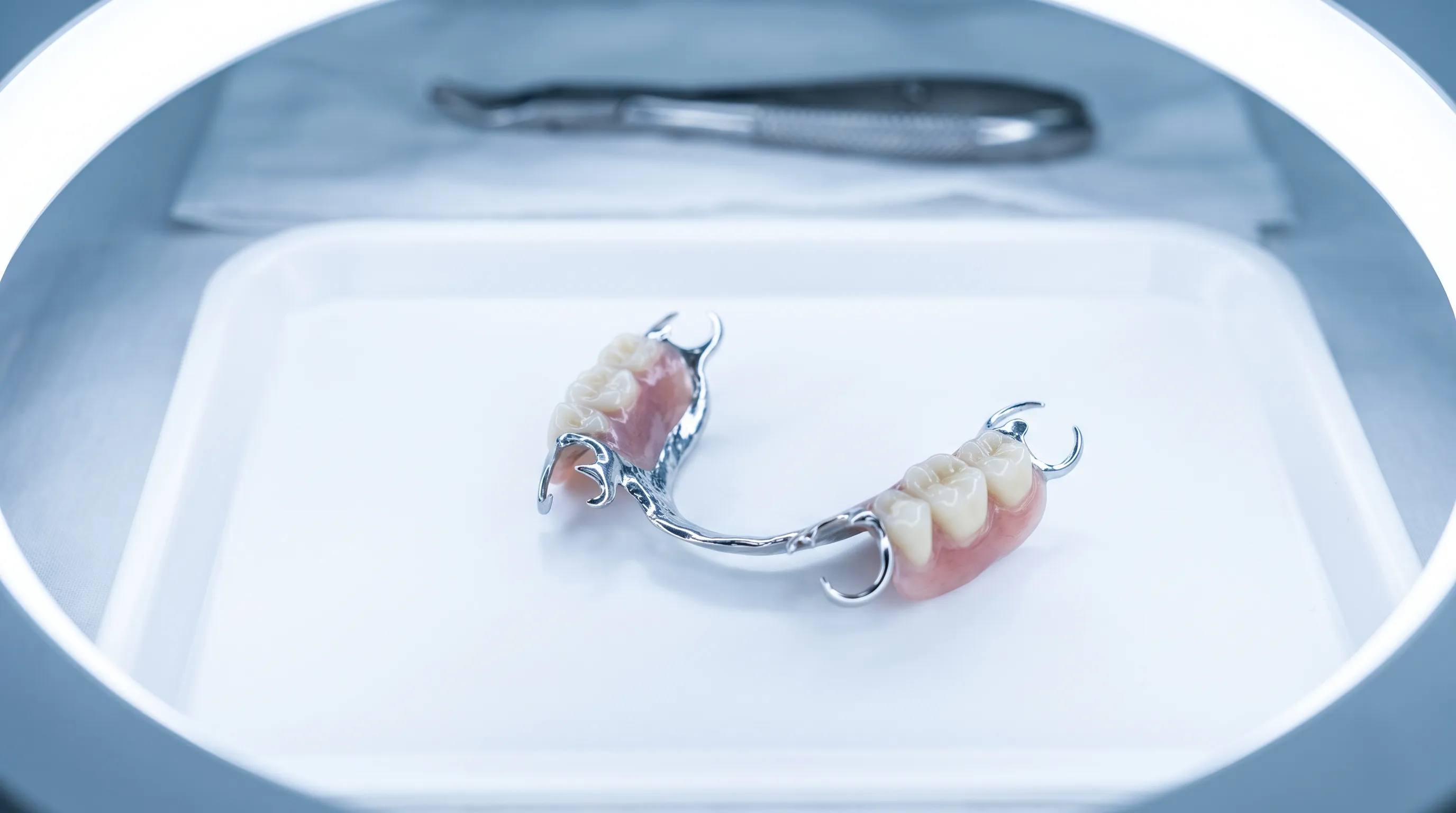
- Visual Profile: These have a slim profile because the metal is strong enough to be thin. The metal framework is visible inside the mouth but usually not from the outside. The clasps are silver and may be visible if they attach to front teeth.
- Aesthetic Pros: The thinness allows for better comfort and less interference with speech. The metal provides excellent support, preventing the acrylic from flexing and looking bulky.
- Aesthetic Cons: The metal clasps can be unsightly if placed on visible teeth. Some patients dislike the "metallic" look inside their mouth.
Losing a tooth is a significant event that affects not just your ability to chew and speak, but also your confidence and self-image. When facing tooth loss, many patients immediately worry about the aesthetic implications of their treatment options. Among the most common solutions for replacing multiple missing teeth is the removable partial denture. However, a frequent concern among patients is exactly what do partials look like once they are placed in the mouth. Will they be obvious? Will they look bulky or artificial? Understanding the visual characteristics of partial dentures is crucial for making an informed decision about your oral health restoration.
This comprehensive guide dives deep into the aesthetics, structure, and visual reality of partial dentures. We will explore the different materials used, how they integrate with your natural smile, and what you can realistically expect during the adjustment period. Whether you are considering a traditional cast metal partial, a flexible resin option, or an acrylic temporary solution, knowing what do partials look like in real-life scenarios will help alleviate anxiety and set realistic expectations. By the end of this article, you will have a clear mental image of these dental appliances and understand how modern dentistry strives to make them as invisible and natural-looking as possible.
Understanding the Structure of Partial Dentures
To truly understand what do partials look like, one must first understand their construction. A partial denture is not a single solid piece of plastic; it is a complex prosthesis designed to mimic both the function and appearance of natural teeth and gums. The visual impact of a partial depends heavily on its three main components: the framework, the artificial teeth, and the retention mechanism.
Free calculatorHeadache Location ChartIdentify headache types by locationOpen the calculatorThe Framework: The Skeleton of the Appliance
The framework is the internal structure that holds the partial together. In traditional partials, this is often made of a cobalt-chromium metal alloy. Visually, this framework looks like a thin, silver-colored lattice that sits against the roof of your mouth (if upper) or under your tongue (if lower). It is designed to be as thin as possible while maintaining strength.
For patients asking what do partials look like regarding the metal base, it is important to note that this metal is usually positioned away from the visible smile line. It rests on the hard palate or the floor of the mouth, areas that are not typically seen when talking or smiling. However, the framework does extend outward to connect with the artificial teeth and the clasps. In flexible partials, the framework is made of a nylon-like thermoplastic material that is pink or gum-colored, eliminating the silver appearance entirely.
The Artificial Teeth: Mimicking Nature
The artificial teeth are the most visible part of the partial. These are typically made from high-quality acrylic resin or porcelain. Modern dental laboratories use shade guides to match the color, translucency, and shape of the artificial teeth to your remaining natural teeth.
When examining what do partials look like up close, you might notice that the artificial teeth are slightly more uniform than natural teeth, which often have unique imperfections. However, skilled technicians can add subtle variations in color and texture to create a more lifelike appearance. The goal is to ensure that when you smile, the transition between your natural teeth and the prosthetic ones is seamless. From a social distance, it is often difficult to distinguish which teeth are real and which are part of the partial.
The Retention Mechanism: Clasps and Connectors
The way a partial stays in your mouth significantly impacts its appearance. Traditional partials use metal clasps that hook around the remaining natural teeth. These clasps are necessary for stability but are often the source of aesthetic concern.
If you are wondering what do partials look like regarding these clasps, imagine a small, curved wire hugging the neck of your natural tooth. Depending on the location of the missing teeth, these clasps may be visible. For gaps in the back of the mouth, the cheeks usually cover the clasps. For gaps in the front, dentists may place the clasps on less visible teeth or use alternative retention methods. Flexible partials use gum-colored extensions that snap into place, avoiding the need for visible metal hardware altogether.
Types of Partial Dentures and Their Aesthetic Differences
Not all partials are created equal. The material and design chosen by your dentist will dramatically influence what do partials look like in your specific case. There are three primary types of removable partial dentures, each with distinct visual characteristics. According to the Mayo Clinic, understanding these differences is key to selecting the right restorative option.
Cast Metal Partial Dentures
Cast metal partials are considered the gold standard for durability and fit. They consist of a metal framework with acrylic gums and teeth attached.
- Visual Profile: These have a slim profile because the metal is strong enough to be thin. The metal framework is visible inside the mouth but usually not from the outside. The clasps are silver and may be visible if they attach to front teeth.
- Aesthetic Pros: The thinness allows for better comfort and less interference with speech. The metal provides excellent support, preventing the acrylic from flexing and looking bulky.
- Aesthetic Cons: The metal clasps can be unsightly if placed on visible teeth. Some patients dislike the "metallic" look inside their mouth.
Acrylic Partial Dentures (Flippers)
Often used as temporary solutions, acrylic partials, commonly known as "flippers," are made entirely of pink acrylic plastic with embedded teeth.
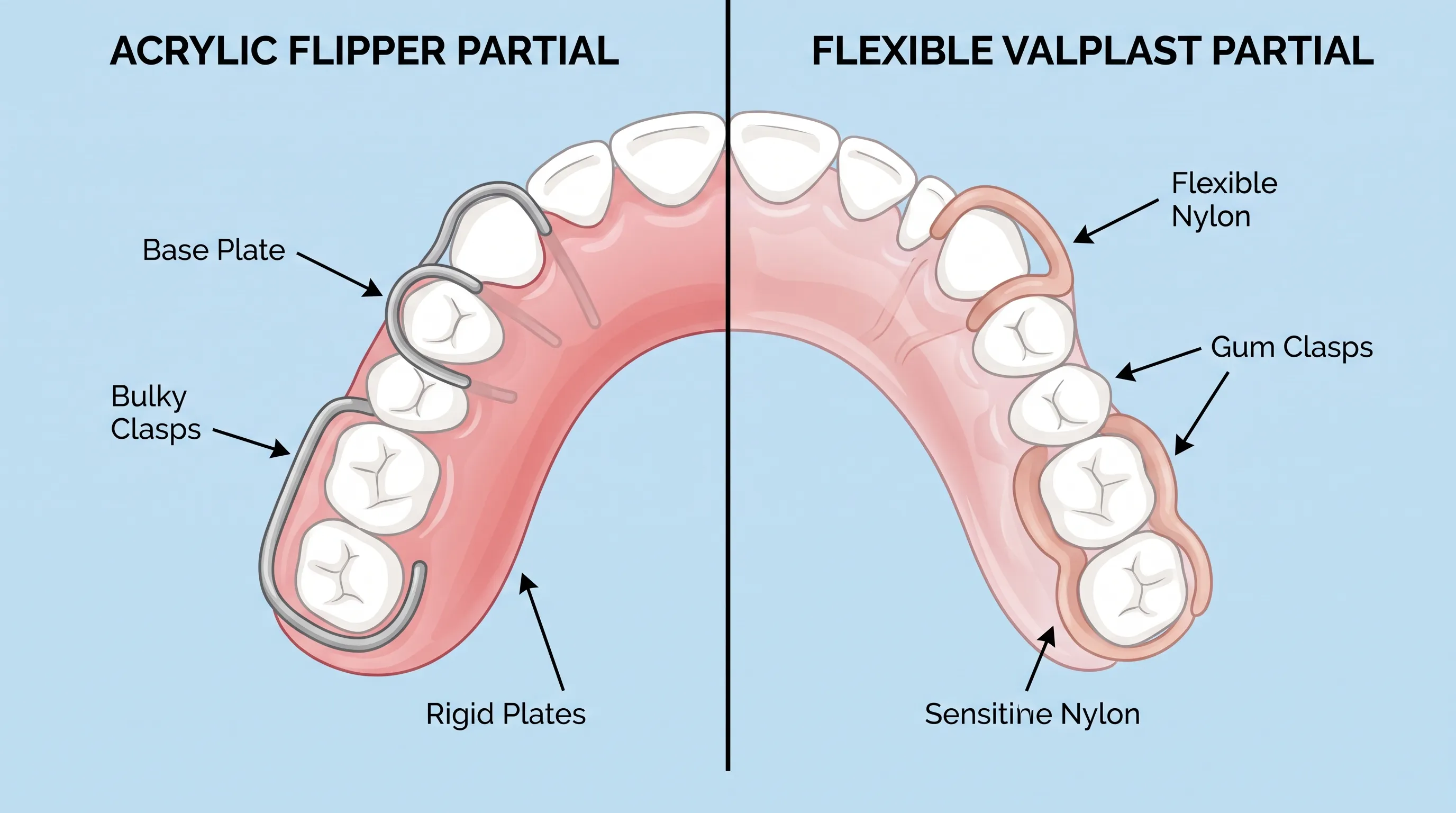
- Visual Profile: These are bulkier than metal partials because acrylic is not as strong as metal and requires more thickness to prevent breaking. The pink acrylic mimics gum tissue but can sometimes look opaque or too bright compared to natural gums.
- Aesthetic Pros: They can be made quickly and are inexpensive. There is no metal visible anywhere.
- Aesthetic Cons: The bulkiness can distort the lip profile slightly, making the area look fuller than natural. The acrylic may stain over time, changing its color and making it look less natural. They are generally not intended for long-term aesthetic perfection.
Flexible Partial Dentures
Flexible partials, such as those made from Valplast or FLEXITE, are a popular choice for patients concerned about visibility.
- Visual Profile: These are made from a thermoplastic nylon material that is flexible and gum-colored. They do not have a metal framework or metal clasps.
- Aesthetic Pros: The absence of metal makes them highly aesthetic. The clasps are tinted to match the gum tissue, blending in seamlessly. They are thinner than acrylic flippers but slightly thicker than metal frameworks.
- Aesthetic Cons: Because the material is flexible, it cannot support the bite force as well as metal, so they are best for replacing fewer teeth. The gum-colored clasps can sometimes trap food debris if not cleaned properly, which might affect their appearance over time.
| Feature | Cast Metal Partial | Acrylic Flipper | Flexible Partial |
|---|---|---|---|
| Primary Material | Cobalt-Chromium Metal & Acrylic | Pink Acrylic Resin | Thermoplastic Nylon |
| Visibility of Hardware | Metal clasps may be visible | No metal, but bulky pink base | Gum-colored clasps, very discreet |
| Profile Thickness | Thin and sleek | Thick and bulky | Moderate thickness |
| Natural Look | High (except for clasps) | Moderate (can look artificial) | Very High (blends with gums) |
| Best For | Long-term durability & function | Temporary replacement | Aesthetics & metal allergies |
Understanding these differences helps clarify what do partials look like for each type. Your dentist will recommend the best option based on the location of your missing teeth, your budget, and your aesthetic priorities.
How Partials Integrate with Your Natural Smile
One of the biggest fears patients have is that their partial will stick out like a sore thumb. However, modern dentistry focuses heavily on integration. When assessing what do partials look like in the context of your unique smile, several factors come into play.
Color Matching and Shade Selection
During the fabrication process, your dentist will use a shade guide to select the exact color of your artificial teeth. This is not just about picking "white." Natural teeth have gradients, translucency at the edges, and slight discolorations near the gum line. High-quality partials replicate these nuances.
If you are wondering what do partials look like regarding color mismatch, rest assured that digital shade matching technology has improved significantly. The goal is to ensure that under various lighting conditions—sunlight, indoor lighting, flash photography—the artificial teeth blend harmoniously with your natural dentition. If your natural teeth are yellowed or stained, the lab can match that tone to avoid a stark contrast that would draw attention to the prosthetic.
Gum Tissue Simulation
The pink portion of the partial, known as the flange, is designed to mimic your gingival tissue. In cast metal and acrylic partials, this is pink acrylic. In flexible partials, it is the same nylon material tinted pink.
The realism of this gum simulation is key to answering what do partials look like. Skilled technicians add subtle textures and color variations to the pink material to resemble the stippling and vascular patterns of real gums. While it may not be perfect under a microscope, from a normal conversational distance, it creates the illusion that the teeth are emerging naturally from your jaw. Over time, however, natural gums may recede or change shape, which can create a small gap between the partial and the gum line. Regular check-ups ensure that the partial continues to look natural as your mouth changes.
Impact on Facial Structure
Missing teeth can cause the lips and cheeks to collapse inward, leading to a sunken appearance. Partials help restore this volume. When asking what do partials look like in terms of facial aesthetics, consider that they provide structural support.
A well-fitted partial fills out the lips and supports the cheeks, giving you a more youthful and vibrant appearance. This is particularly noticeable in patients who have lost multiple posterior teeth. The restoration of vertical dimension (the height of the face when teeth are together) can reduce wrinkles around the mouth and improve the overall balance of facial features. Thus, the partial doesn't just look like teeth; it looks like a rejuvenated face.
Common Aesthetic Concerns and Misconceptions
Despite advancements, misconceptions persist. Let's address some common worries about what do partials look like and separate fact from fiction.
"They Will Look Bulky and Large"
This is a common fear, especially for those who have seen older, ill-fitting dentures. While acrylic flippers are indeed bulky, cast metal and flexible partials are designed to be minimally invasive. The metal framework is incredibly thin, often less than a millimeter thick. Flexible partials are also streamlined. The perception of bulkiness often comes from the initial adjustment phase, where your tongue and cheeks are not yet used to the new object. As you adapt, the sensation of bulkiness diminishes, and visually, the partial blends into the natural contours of your mouth.
"The Metal Clasps Will Be Obvious When I Laugh"
If you need a partial for front teeth, metal clasps can be a concern. However, dentists are strategic about placement. They may place clasps on premolars or molars that are hidden by the corners of your mouth when you smile broadly. If clasps must be on visible teeth, tooth-colored composite bonding can sometimes be applied to the tooth to mask the metal, or a flexible partial can be chosen to eliminate metal entirely. Therefore, what do partials look like when laughing is largely dependent on the design choices made by your dental team.
"They Will Change My Speech Appearance"
Some patients worry that a partial will cause a lisp or alter the way their lips move. Initially, there may be a slight adjustment period where speech sounds different. However, this is temporary. Once the muscles of the tongue and lips adapt to the new space, speech returns to normal. Visually, there is no change in how your mouth moves during speech once you are accustomed to the appliance. In fact, by replacing missing teeth, you may find it easier to pronounce certain sounds that were difficult before, improving both auditory and visual communication.
Maintenance and Long-Term Aesthetics
The appearance of your partial is not static; it changes over time based on how well you care for it. Knowing what do partials look like after years of use depends heavily on your hygiene habits. The Cleveland Clinic provides detailed guidelines on caring for removable dentures to maintain their appearance and function.
Staining and Discoloration
Acrylic and nylon materials are porous to some extent. Coffee, tea, red wine, and tobacco can stain the artificial teeth and the pink gum portions. Over time, a white partial may turn yellowish, and pink gums may darken. This can make the partial look old and unnatural. To maintain the original look, it is essential to clean the partial daily with a non-abrasive cleaner and avoid soaking it in bleach, which can damage the material. Regular professional cleaning by your dentist can also restore the brightness of the appliance.
Wear and Tear
Artificial teeth wear down faster than natural enamel. Over several years, the biting surfaces may flatten, changing the appearance of the teeth. Additionally, the clasps may loosen, causing the partial to sit differently in the mouth. A loose partial might rotate or shift, making it more visible than when it was first fitted. Regular adjustments ensure that the partial remains secure and aesthetically pleasing. If you notice changes in what do partials look like over time, such as increased visibility or discoloration, consult your dentist for a relining or replacement.
Bone Resorption and Fit
Even with partials, the underlying bone can resorb (shrink) over time, especially if the missing teeth have been gone for a long time. This can create gaps between the partial and the gums. These gaps can trap food and make the partial look like it is floating rather than sitting snugly. Periodic relining of the partial fills these gaps, restoring the tight fit and natural appearance. This maintenance is crucial for ensuring that what do partials look like remains consistent with your natural anatomy.
Alternatives to Removable Partials
While partials are a great option, they are not the only one. Comparing them to other treatments helps contextualize what do partials look like relative to other choices.
Dental Bridges
A dental bridge is a fixed prosthetic that is cemented onto adjacent natural teeth.
- Appearance: Bridges look very natural because there are no clasps or removable plates. They are indistinguishable from natural teeth.
- Comparison: Unlike partials, bridges do not have any visible hardware. However, they require grinding down healthy adjacent teeth, which is a significant drawback. For patients prioritizing aesthetics above all else and willing to undergo irreversible preparation, bridges may offer a superior look to removable partials.
Dental Implants
Implants are titanium posts surgically placed into the jawbone, topped with a crown.
- Appearance: Implants are the most natural-looking option available. They emerge from the gum line just like natural teeth, with no clasps, plates, or connectors visible.
- Comparison: When asking what do partials look like compared to implants, the difference is stark. Implants offer superior aesthetics and function but come with a higher cost and surgical requirement. Partials are a non-surgical, more affordable alternative that still offers good aesthetics, especially with flexible designs.
Practical Tips for Enhancing the Appearance of Your Partials
If you already have partials or are planning to get them, here are actionable tips to ensure they look their best.
- Choose the Right Material: If aesthetics are your top priority and you have metal allergies or visible gaps, opt for flexible partials. Discuss with your dentist whether tooth-colored clasps are an option for your specific case.
- Maintain Oral Hygiene: Keep your natural teeth and gums healthy. Healthy gums provide a better foundation for the partial, ensuring a snug fit and natural look. Inflamed or receding gums can make the partial look ill-fitting.
- Regular Dental Visits: Visit your dentist every six months. They can polish the partial to remove stains, adjust the fit to prevent shifting, and check the condition of the artificial teeth.
- Handle with Care: Dropping a partial can crack the acrylic or bend the metal clasps, altering its fit and appearance. Always handle it over a sink filled with water or a towel to cushion any falls.
- Be Patient During Adjustment: Give yourself time to get used to the look and feel. Practice smiling and speaking in front of a mirror. You will likely find that the partial is far less noticeable to others than it is to you.
Frequently Asked Questions
What do partials look like compared to full dentures?
Partials are significantly smaller and less bulky than full dentures. While full dentures replace an entire arch of teeth and rest solely on the gums, partials leave your natural teeth in place. Visually, this means partials often have metal or plastic clasps that hook onto existing teeth, whereas full dentures have a continuous gum-colored base. Partials generally look more natural because they utilize your remaining natural structure for support and aesthetics.
Are metal clasps on partials visible when I smile?
It depends on the location of the missing teeth. If the partial is replacing back teeth, the clasps are usually hidden by your cheeks. If the gap is in the front, metal clasps may be visible. However, dentists can use aesthetic strategies such as placing clasps on less visible teeth, using tooth-colored composite to mask them, or recommending flexible partials that use gum-colored retainers instead of metal.
Do partial dentures look fake or unnatural?
Modern partial dentures are highly customized. The artificial teeth are matched to the shade and shape of your natural teeth, and the gum-colored base is textured to resemble real tissue. While a close inspection might reveal the prosthetic nature, from a normal social distance, high-quality partials look very natural. The key is working with a skilled dentist and laboratory technician who prioritize aesthetic details.
How long does it take to get used to the look of partials?
Most patients adjust to the appearance of their partials within two to four weeks. Initially, you may feel self-conscious about the bulkiness or the presence of clasps. However, as your facial muscles adapt and you become more confident, the partial becomes a seamless part of your smile. Mirrors can be deceptive during this period; ask trusted friends or family for feedback, as they often notice the improvement in your smile rather than the appliance itself.
Can I get partials that don't have visible metal?
Yes, flexible partial dentures are an excellent option for avoiding visible metal. Made from thermoplastic materials like Valplast, these partials use gum-colored extensions to anchor onto your natural teeth. They blend in with your tissue, making them virtually invisible when worn. This makes them a popular choice for patients who are concerned about what do partials look like and want a discreet solution.
Conclusion
Understanding what do partials look like is essential for anyone considering this restorative option. Far from the bulky, obvious appliances of the past, modern partial dentures are sophisticated devices designed to blend seamlessly with your natural smile. Whether you choose a durable cast metal partial, a cost-effective acrylic flipper, or a discreet flexible partial, each option offers unique aesthetic benefits.
The key to a natural look lies in the customization of color, shape, and fit, as well as the strategic placement of retention mechanisms. With proper care and regular dental maintenance, your partial can remain a comfortable, functional, and aesthetically pleasing part of your life for many years. By addressing your concerns and working closely with your dental provider, you can achieve a restored smile that looks natural and feels confident. Remember, the goal of dentistry is not just to replace teeth, but to restore your quality of life and self-esteem, and partial dentures are a powerful tool in achieving that goal. For more information on tooth loss and restoration, you can refer to resources from the National Institute of Dental and Craniofacial Research.
How we work
Researched and drafted with AI assistance, then reviewed by a human editor against the cited sources.
This article is general health information, not medical advice. Consult a qualified healthcare professional about your own situation.