Eye Floaters and Headaches: Understanding the Connection, Causes, and When to Seek Help

Key points
- Vitrectomy: A surgical procedure where the vitreous gel is removed and replaced with a saline solution. This eliminates floaters but carries risks such as cataracts and retinal detachment. It is generally reserved for severe cases (Mayo Clinic).
- Laser Vitreolysis: A laser is used to break up large floaters into smaller, less noticeable pieces. This is less invasive than surgery but is not suitable for all types of floaters and carries its own risks.
Have you ever looked at a clear blue sky or a bright white wall and noticed tiny, translucent specks drifting across your field of vision? These are eye floaters, a common visual phenomenon that affects millions of people worldwide. For many, they are a minor annoyance, easily ignored as the brain learns to filter them out. However, when these drifting spots are accompanied by persistent or severe head pain, the experience can be far more distressing. The combination of eye floaters and headaches often raises immediate concerns about underlying health issues, ranging from simple eye strain to more complex neurological or ocular conditions.
Understanding the relationship between these two symptoms is crucial for maintaining both your visual health and overall well-being. While they can occur independently, their simultaneous presence often points to specific physiological mechanisms at play. In some cases, the connection is benign, such as the visual aura preceding a migraine. In others, it may signal a need for urgent medical intervention, such as in cases of retinal detachment or intraocular inflammation. This comprehensive guide delves deep into the anatomy of the eye, the neurology of head pain, and the intricate ways these systems interact. We will explore the common causes, debunk myths, and provide actionable advice on when to seek professional care. By the end of this article, you will have a clearer understanding of why you might be experiencing eye floaters and headaches together and what steps you can take to manage them effectively.
The Anatomy of Vision: Understanding Eye Floaters
To comprehend why eye floaters and headaches might occur together, we must first understand what floaters actually are. Contrary to popular belief, floaters are not objects on the surface of your eye. They are located deep within the interior of the eyeball. The majority of the eye's volume is filled with a clear, gel-like substance called the vitreous humor. This substance helps maintain the eye's spherical shape and allows light to pass through to the retina, the light-sensitive tissue at the back of the eye (National Eye Institute).
Free calculatorWater Intake CalculatorCalculate daily water needsOpen the calculator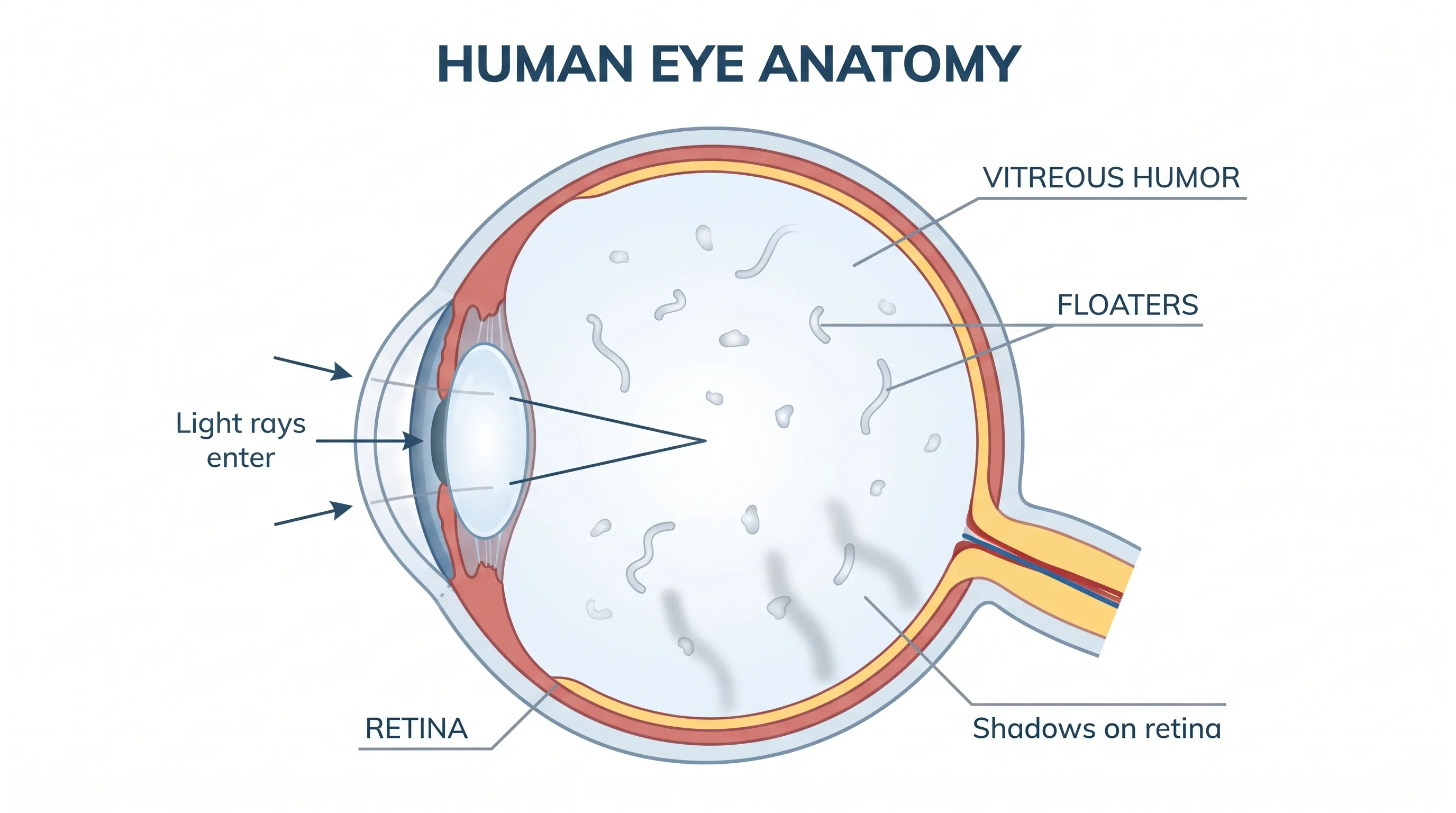
What Are Floaters Exactly?
As we age, the vitreous humor undergoes natural changes. It begins to liquefy and shrink, a process known as syneresis. During this process, microscopic collagen fibers within the vitreous can clump together. These clumps cast tiny shadows on the retina, which you perceive as floaters. They can appear as black or gray dots, squiggly lines, thread-like strands, or cobwebs. Because they are suspended in the gel, they move when your eyes move, darting away when you try to look directly at them (Mayo Clinic).
While most floaters are a result of normal aging processes, particularly after age 50, they can also occur in younger individuals, especially those who are nearsighted (myopic). Nearsighted eyes are often longer, which can stretch the vitreous and accelerate these changes. It is important to note that while floaters themselves are usually harmless, their sudden appearance can sometimes indicate a more serious issue, especially when paired with other symptoms like headaches.
The Role of the Retina
The retina is the critical interface where light is converted into neural signals sent to the brain. Any disturbance in the vitreous humor can affect the retina. If the shrinking vitreous pulls too hard on the retina, it can cause a tear. This is a significant risk factor for retinal detachment, a medical emergency. When patients report eye floaters and headaches, clinicians must carefully rule out retinal traction or tears, as the pain may not always originate from the eye itself but from the referred pain pathways or associated stress responses (Cleveland Clinic).
Headaches: More Than Just Pain
Headaches are one of the most common medical complaints, with numerous types and triggers. To understand the link with visual disturbances, we need to categorize the types of headaches that are most frequently associated with visual symptoms. Not all headaches are created equal, and the nature of the pain can provide clues to its origin.
Tension-Type Headaches
Tension-type headaches are the most common form, often described as a tight band around the forehead. They are frequently triggered by stress, poor posture, and eye strain. While tension headaches do not typically cause visual auras, the muscle tension in the neck and shoulders can refer pain to the head and behind the eyes. In cases of severe digital eye strain, individuals may notice existing floaters more prominently due to the intense focus required on screens, leading to a perceived correlation between eye floaters and headaches (American Optometric Association).
Migraines and Visual Aura
Migraines are a neurological condition characterized by moderate to severe throbbing pain, often on one side of the head. A significant subset of migraine sufferers experiences "aura" before the pain sets in. Visual auras can include flashing lights, zigzag patterns, blind spots, and yes, floaters or shimmering spots. These visual disturbances are caused by abnormal electrical activity in the brain's visual cortex. For many, the onset of these visual symptoms is a warning sign that a headache is imminent. Understanding this pattern is key to managing eye floaters and headaches effectively, as early intervention can sometimes abort the migraine attack (National Institute of Neurological Disorders and Stroke).
Cluster Headaches
Cluster headaches are less common but extremely painful, occurring in cyclical patterns. They are often centered around one eye and can cause redness, tearing, and drooping of the eyelid. While visual floaters are not a primary symptom of cluster headaches, the intense pain and autonomic symptoms can make patients hyper-aware of any visual anomalies. Differentiating between the visual aura of a migraine and the localized pain of a cluster headache is essential for proper treatment.
The Connection: Why Do Eye Floaters and Headaches Occur Together?
The co-occurrence of eye floaters and headaches can be puzzling. In many cases, the two symptoms are not directly causally linked but are rather concurrent results of a third factor. However, there are specific conditions where the connection is direct and physiological. Let’s explore the primary scenarios where these symptoms intersect.
1. Ocular Migraines (Retinal Migraines)
An ocular migraine, also known as a retinal migraine, is a rare condition that causes temporary vision loss or visual disturbances in one eye. Unlike typical migraines with aura, which affect both eyes, ocular migraines are monocular. Symptoms may include the appearance of floaters, flashing lights, or a partial loss of vision. These episodes are usually painless, but they can be followed by a severe headache. The mechanism involves spasms in the blood vessels supplying the retina. If you experience eye floaters and headaches in this pattern, it is crucial to consult a neurologist or ophthalmologist to rule out other vascular issues (American Academy of Ophthalmology).
2. Posterior Vitreous Detachment (PVD)
Posterior Vitreous Detachment is a common age-related condition where the vitreous gel separates from the retina. As the vitreous pulls away, it can cause a sudden shower of new floaters and flashes of light. While PVD itself is not typically painful, the anxiety and stress associated with sudden vision changes can trigger tension headaches. Furthermore, if the detachment causes a retinal tear, the resulting inflammation or subsequent repair processes can lead to discomfort. Patients often describe a sense of pressure or mild ache in the eye, which can radiate into a headache. Recognizing the signs of PVD is vital when evaluating eye floaters and headaches in older adults (Mayo Clinic).
3. Uveitis and Intraocular Inflammation
Uveitis is inflammation of the uvea, the middle layer of the eye. It can cause redness, pain, light sensitivity, and blurred vision. Inflammatory cells can enter the vitreous humor, appearing as floaters. The pain associated with uveitis is often described as a deep ache in the eye that can extend into the head, mimicking a headache. This is a serious condition that requires prompt treatment with anti-inflammatory medications to prevent vision loss. If your eye floaters and headaches are accompanied by eye redness and light sensitivity, seek immediate medical care (National Eye Institute).
4. Digital Eye Strain and Dry Eyes
In our modern digital age, prolonged screen time is a major contributor to both visual discomfort and head pain. Staring at screens reduces blink rate, leading to dry eyes. Dry eyes can cause blurred vision and make existing floaters more noticeable as the tear film becomes irregular. Simultaneously, the focusing effort required for near work strains the ciliary muscles in the eye and the extraocular muscles, leading to tension headaches. This functional link explains why many young professionals report eye floaters and headaches after long workdays. The floaters were likely already there, but the strain and dryness made them symptomatic.
Serious Conditions: When to Worry
While most instances of eye floaters and headaches are benign, there are serious conditions that require immediate medical attention. Ignoring these warning signs can lead to permanent vision loss or other severe health complications.
Retinal Detachment
Retinal detachment occurs when the retina pulls away from the back of the eye. It is often preceded by PVD. Symptoms include a sudden increase in floaters, flashes of light, and a shadow or curtain coming over part of your vision. While retinal detachment itself is painless, the stress and panic it induces can trigger severe headaches. Additionally, if the detachment is traumatic, there may be associated pain. This is a surgical emergency. If you suspect retinal detachment, do not wait; go to the emergency room or an eye specialist immediately (Cleveland Clinic).
Vitreous Hemorrhage
A vitreous hemorrhage is bleeding into the vitreous humor. It can be caused by diabetes, trauma, or retinal tears. The blood cells appear as dark floaters or a reddish haze. Depending on the cause, there may be associated pain or headache. Diabetic retinopathy, for example, can cause both visual disturbances and systemic issues that contribute to headaches. Managing underlying conditions like diabetes is crucial to preventing these complications (Centers for Disease Control and Prevention).
Increased Intracranial Pressure
Rarely, eye floaters and headaches can be a sign of increased pressure inside the skull. Conditions such as idiopathic intracranial hypertension (IIH) or brain tumors can cause papilledema (swelling of the optic nerve), which leads to visual obscurations that may be mistaken for floaters. These visual changes are often transient and associated with position changes. The headaches are typically worse in the morning or when lying down. If you have persistent headaches, visual changes, and nausea, a neurological evaluation is necessary (Mayo Clinic).
Diagnostic Approaches: How Doctors Evaluate Your Symptoms
If you present to a healthcare provider with complaints of eye floaters and headaches, they will perform a thorough evaluation to determine the underlying cause. This process typically involves a combination of patient history, physical examination, and specialized testing.
Comprehensive Eye Exam
The cornerstone of diagnosis is a dilated eye exam. An ophthalmologist or optometrist will use eye drops to widen your pupils, allowing them to examine the retina and vitreous humor in detail. They will look for signs of PVD, retinal tears, inflammation, or bleeding. Optical Coherence Tomography (OCT) may be used to get cross-sectional images of the retina, providing high-resolution details of any structural abnormalities (American Academy of Ophthalmology).
Neurological Assessment
If the eye exam is normal, or if the headache characteristics suggest a neurological origin, a neurological assessment may be required. This includes checking reflexes, coordination, and visual fields. If a migraine is suspected, the doctor will review your history of headaches, triggers, and family history. In cases where increased intracranial pressure is a concern, imaging studies such as an MRI or CT scan of the brain may be ordered to rule out tumors or other structural issues (Mayo Clinic).
Comparison of Diagnostic Tools
| Diagnostic Tool | Purpose | What It Detects | Invasiveness |
|---|---|---|---|
| Dilated Eye Exam | Visualize retina and vitreous | Floaters, tears, detachment, inflammation | Non-invasive |
| Optical Coherence Tomography (OCT) | High-res imaging of retina | Macular holes, edema, subtle detachments | Non-invasive |
| MRI Brain | Soft tissue imaging of brain | Tumors, MS, vascular anomalies | Non-invasive |
| CT Scan | Quick imaging of brain/bone | Bleeding, fractures, large masses | Non-invasive (radiation) |
| Lumbar Puncture | Measure cerebrospinal fluid pressure | Intracranial hypertension, infection | Invasive |
Treatment and Management Strategies
The treatment for eye floaters and headaches depends entirely on the underlying cause. There is no one-size-fits-all solution, but various strategies can help manage symptoms and improve quality of life.
Managing Benign Floaters
For most people, floaters are harmless and do not require treatment. The brain often adapts to them through a process called neuroadaptation, where it learns to ignore the visual noise. However, if floaters are significantly impacting your vision, several options exist:
- Vitrectomy: A surgical procedure where the vitreous gel is removed and replaced with a saline solution. This eliminates floaters but carries risks such as cataracts and retinal detachment. It is generally reserved for severe cases (Mayo Clinic).
- Laser Vitreolysis: A laser is used to break up large floaters into smaller, less noticeable pieces. This is less invasive than surgery but is not suitable for all types of floaters and carries its own risks.
Treating Headaches and Migraines
Managing the headache component often involves a combination of lifestyle changes and medication:
- Acute Medications: Over-the-counter pain relievers like ibuprofen or acetaminophen can help with tension headaches. For migraines, triptans or gepants may be prescribed to stop the attack (National Institute of Neurological Disorders and Stroke).
- Preventive Medications: If headaches are frequent, beta-blockers, antidepressants, or anticonvulsants may be used to reduce frequency and severity.
- Lifestyle Modifications: Identifying and avoiding triggers such as certain foods, stress, and lack of sleep is crucial. Regular exercise and hydration also play a significant role.

Addressing Digital Eye Strain
Since digital eye strain is a common contributor to eye floaters and headaches, adopting healthy screen habits is essential:
- The 20-20-20 Rule: Every 20 minutes, look at something 20 feet away for at least 20 seconds. This relaxes the focusing muscles in the eye (American Optometric Association).
- Blue Light Filters: Using blue light filtering glasses or software settings can reduce eye strain, although scientific evidence on their efficacy is mixed. Many users report subjective improvement.
- Artificial Tears: Lubricating eye drops can alleviate dryness, making floaters less noticeable and reducing irritation.
Preventive Measures and Lifestyle Adjustments
Prevention is always better than cure. While you cannot always prevent age-related changes in the eye, you can take steps to minimize the risk of complications and reduce the frequency of headaches.
Nutrition for Eye and Brain Health
A diet rich in antioxidants and omega-3 fatty acids supports both eye and brain health. Foods like leafy greens, fish, nuts, and berries can help protect against oxidative stress. Staying hydrated is also critical, as dehydration can exacerbate both dry eyes and headaches. Aim for at least eight glasses of water a day, adjusting for activity level and climate.
Stress Management
Stress is a major trigger for both tension headaches and migraines. Incorporating stress-reduction techniques such as mindfulness meditation, yoga, or deep breathing exercises can help lower the frequency of episodes. Regular physical activity also releases endorphins, which are natural painkillers and mood elevators.
Regular Eye Exams
Routine eye exams are vital for early detection of potential issues. Even if you have no symptoms, regular check-ups can identify risk factors for retinal detachment or other conditions. If you are nearsighted or have a family history of eye disease, more frequent exams may be recommended. Early intervention can prevent minor issues from becoming major problems involving eye floaters and headaches (National Eye Institute).
Frequently Asked Questions
Can eye strain cause both floaters and headaches?
Yes, prolonged digital screen use can lead to digital eye strain, which often causes tension headaches. While eye strain does not directly create new floaters, it can make you more aware of existing ones due to increased visual focus and fatigue. The dryness associated with reduced blinking during screen time can also distort vision, making floaters appear more prominent. Implementing the 20-20-20 rule and using artificial tears can help mitigate these effects (American Optometric Association).
Are eye floaters and headaches a sign of a brain tumor?
While rare, certain brain tumors can cause increased intracranial pressure, leading to headaches and visual disturbances. However, these are typically accompanied by other severe neurological symptoms such as seizures, weakness, or personality changes. Most cases of eye floaters and headaches are benign or related to migraines, eye strain, or age-related eye changes. If you have persistent, worsening headaches and new visual symptoms, a medical evaluation is warranted to rule out serious conditions (Mayo Clinic).
How long do floaters last after a migraine?
Visual auras associated with migraines, which may look like floaters, flashing lights, or zigzag lines, typically last between 20 to 60 minutes. These are temporary neurological events. True physiological floaters caused by vitreous changes are permanent but may become less noticeable over time as the brain adapts. It is important to distinguish between the transient visual phenomena of a migraine aura and persistent floaters that remain after the headache has resolved (National Institute of Neurological Disorders and Stroke).
When should I see a doctor for eye floaters and headaches?
Seek immediate medical attention if you experience a sudden shower of new floaters, flashes of light, a shadow in your peripheral vision, or a sudden severe headache unlike any previous one. These could indicate retinal detachment, vitreous hemorrhage, or other serious conditions. Additionally, if your headaches are becoming more frequent or severe, or if they interfere with daily life, consult a healthcare provider for a proper diagnosis and treatment plan (Cleveland Clinic).
Can dehydration cause eye floaters and headaches?
Dehydration is a common trigger for headaches and can affect the volume of the vitreous humor in the eye. While it doesn't directly cause floaters to form, severe dehydration can exacerbate existing symptoms and make visual disturbances more prominent. It can also lead to dry eyes, which irritates the surface of the eye and contributes to visual discomfort. Maintaining adequate hydration is a simple yet effective strategy for managing both headaches and general eye comfort.
Conclusion
The experience of dealing with eye floaters and headaches can be unsettling, but it is a common complaint with a wide range of causes, from benign age-related changes to manageable lifestyle factors. Understanding the distinction between harmless vitreous changes and signs of serious conditions like retinal detachment or neurological issues is empowering. By paying attention to the nature of your symptoms—such as the suddenness of onset, the presence of flashes, or the pattern of pain—you can better communicate with your healthcare providers.
Most importantly, do not ignore sudden changes in your vision or new, severe headaches. Early diagnosis is key to preserving vision and managing pain effectively. Whether through lifestyle adjustments like the 20-20-20 rule, dietary changes, or medical interventions, there are many ways to find relief. Keep a symptom diary, stay hydrated, and prioritize regular eye exams. Your eyes and your brain are intricately connected, and caring for one often benefits the other. With the right knowledge and proactive care, you can navigate the challenges of eye floaters and headaches with confidence and clarity.
How we work
Researched and drafted with AI assistance, then reviewed by a human editor against the cited sources.
This article is general health information, not medical advice. Consult a qualified healthcare professional about your own situation.