Bell's Palsy vs Stroke: How to Tell the Difference and When to Act
The sudden appearance of a drooping face is one of the most alarming visual symptoms a person or their loved one can witness. When facial muscles suddenly lose strength on one side, the immediate and often terrifying question arises: is this a medical emergency, or a temporary nerve condition? Understanding the critical distinction between bell's palsy vs stroke is not just academic knowledge; it is a life-saving skill that determines the speed and appropriateness of medical intervention. Both conditions share a strikingly similar outward appearance, yet their underlying mechanisms, treatment protocols, and long-term prognoses differ radically. While one requires immediate emergency medical activation to prevent permanent brain damage or death, the other typically responds well to outpatient pharmacological management and supportive care. This comprehensive guide will walk you through the neurological foundations, clinical differentiators, diagnostic pathways, and evidence-based treatment frameworks for both conditions, empowering you with the medical literacy needed to act decisively and calmly during a neurological crisis.
Understanding the Neurological Divide: Central Versus Peripheral Pathways
To accurately distinguish between facial paralysis stemming from a vascular brain event and that caused by cranial nerve inflammation, one must first understand the anatomical architecture of motor nerve pathways. The human face is controlled by the seventh cranial nerve, commonly known as the facial nerve (CN VII). This intricate nerve originates deep within the brainstem, exits the skull through the stylomastoid foramen, and branches into five major divisions that innervate the muscles of facial expression, lacrimal glands, taste receptors on the anterior two-thirds of the tongue, and sensory fibers in the ear canal.
Free calculatorLab Values Reference ChartComplete reference chart for medical lab valuesOpen the calculatorThe fundamental difference between bell's palsy vs stroke lies precisely in where along this pathway the disruption occurs. In a stroke, the injury originates in the central nervous system. Either an ischemic blockage or a hemorrhagic bleed damages the cerebral cortex or the internal capsule, disrupting the upper motor neurons that send signals from the brain to the facial nerve nucleus in the brainstem. Conversely, Bell's palsy is a peripheral neuropathy. The damage occurs after the nerve exits the central nervous system, typically within the narrow, bony Fallopian canal. When this nerve swells due to inflammation, it becomes compressed against the unyielding walls of the canal, leading to ischemia and temporary paralysis of the fibers it carries.
Upper Motor Neuron Versus Lower Motor Neuron Lesions
Medical professionals classify these injuries based on neuroanatomical principles that directly dictate symptom presentation. Upper motor neuron (UMN) lesions, which characterize most facial strokes, affect the cortical pathways descending from the brain. Crucially, the upper third of the face receives bilateral cortical input. This means both the left and right motor cortices send overlapping signals to the muscles responsible for raising the eyebrows and wrinkling the forehead. Consequently, when a stroke damages one hemisphere, the intact opposite hemisphere continues to stimulate the upper facial muscles. The forehead remains functional.
Lower motor neuron (LMN) lesions, characteristic of Bell's palsy, affect the facial nerve after it has integrated bilateral signals and exited the brainstem. A single peripheral nerve controls all ipsilateral facial muscles. When inflammation or compression severs or blocks this peripheral pathway, the entire half of the face loses motor function. There is no compensatory crossover. This neuroanatomical reality explains why a paralyzed forehead points toward a peripheral lesion, while a preserved forehead alongside lower facial droop points toward a central event.
Viral Triggers & Inflammatory Pathways
The etiology of Bell's palsy remains a subject of ongoing research, though the prevailing medical consensus points strongly toward viral reactivation and immune-mediated inflammation. The most frequently implicated pathogens are the herpes simplex virus type 1 (HSV-1), responsible for cold sores, and the varicella-zoster virus (VZV), which causes shingles. Other viruses, including Epstein-Barr and cytomegalovirus, have also been linked in clinical studies. When these dormant viruses reactivate, they trigger a localized inflammatory cascade within the facial nerve sheath. Edema (swelling) rapidly develops within the confined space of the temporal bone, compressing the nerve fibers, impairing blood flow, and halting neural transmission. Unlike stroke, which stems from atherosclerosis, atrial fibrillation, hypertension, or vascular malformations, Bell's palsy is not driven by systemic blood flow disruption or plaque rupture.
Clinical Presentation & Symptom Mapping
Recognizing the nuanced differences in how these conditions manifest is the cornerstone of effective triage. While unilateral facial droop is the hallmark feature, the accompanying symptoms, timing, and pattern of muscle involvement create a distinct clinical fingerprint for each diagnosis.
| Clinical Feature | Bell's Palsy | Ischemic/Hemorrhagic Stroke |
|---|---|---|
| Forehead Movement | Impaired/Absent (Cannot wrinkle or raise eyebrow on affected side) | Typically Preserved (Forehead muscles remain functional due to bilateral innervation) |
| Lower Face | Pronounced droop, flattened nasolabial fold, asymmetric smile | Droop, mouth pulls to unaffected side, asymmetric smile |
| Eye Closure | Incomplete or impossible closure (lagophthalmos) on affected side | Usually intact, though visual field deficits may occur |
| Symptom Onset | Gradual, progressing over 24 to 72 hours | Sudden, instantaneous, or rapidly worsening within minutes |
| Sensory Changes | Facial numbness/tingling, hyperacusis (loud sound sensitivity), altered taste | May include contralateral limb numbness, tingling, or paresthesia |
| Systemic Signs | Often none, occasionally mild ear pain behind the jaw | Severe headache, confusion, aphasia, dysarthria, vertigo, gait instability, unilateral arm/leg weakness |
| Body Involvement | Strictly isolated to one side of the face | Frequently involves contralateral arm and/or leg weakness/paralysis |
Understanding bell's palsy vs stroke requires careful observation of this entire constellation of signs rather than relying solely on the presence of facial asymmetry.
The Forehead Sign: A Crucial Clinical Clue
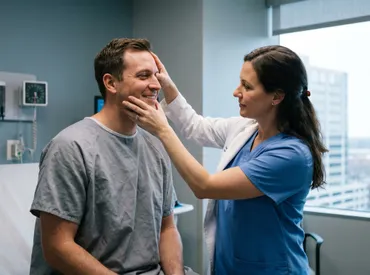
The forehead wrinkle test remains one of the most reliable bedside differentiators. A clinician or caregiver can simply ask the individual to raise both eyebrows or wrinkle their forehead as high as possible. In Bell's palsy, the affected side will appear completely smooth, with no visible horizontal creases. The eyelid may droop, and the brow itself may sag. In a typical cortical stroke, the patient will still be able to elevate both eyebrows symmetrically, even while the lower half of one side droops noticeably. This clinical pearl is standard teaching in medical schools worldwide because it directly reflects the bilateral cortical innervation of the frontalis muscle versus the unilateral innervation of the orbicularis oris and buccinator muscles.
Onset Speed & Symptom Evolution
Time is perhaps the most definitive differentiator. Bell's palsy rarely strikes without warning over a matter of minutes. Patients often notice a subtle heaviness or awkwardness when chewing on one side, followed by noticeable drooping that worsens progressively over one to three days. The paralysis typically plateaus before any improvement begins. Stroke, however, operates on a drastically accelerated timeline. Neurovascular occlusion or hemorrhage causes immediate, focal tissue ischemia. Symptoms peak rapidly, often reaching maximum severity within minutes. The B.E. F.A.S.T. acronym was specifically developed to highlight the suddenness and severity of stroke onset. Delaying medical evaluation to see if symptoms improve is dangerous and contradicts evidence-based stroke protocols.
Accompanying Systemic Symptoms
Beyond the face, Bell's palsy often produces highly specific cranial nerve VII symptoms that are entirely absent in typical strokes. Patients may report a diminished or metallic taste sensation on the front two-thirds of the tongue, heightened sensitivity to ordinary noises due to paralysis of the stapedius muscle (hyperacusis), or decreased tear production leading to paradoxical eye watering. A dull ache behind the ear or along the jawline is also common in the prodromal phase. Stroke, conversely, rarely presents with isolated facial pain or taste changes. Instead, it manifests with profound central deficits: sudden confusion, slurred or incomprehensible speech (dysarthria or aphasia), profound loss of vision in one or both eyes, sudden loss of coordination or balance, and a thunderclap headache in hemorrhagic cases. The presence of these systemic red flags should immediately trigger emergency services activation.
Diagnostic Pathways & Medical Evaluation
Once a patient arrives at an emergency department or neurological clinic, the diagnostic approach diverges sharply based on the suspected pathology. While both conditions require prompt assessment, the tools, urgency, and imaging protocols are tailored to either vascular emergencies or peripheral neuropathy workups.
Clinical Examination & Standardized Scales
Physicians begin with a comprehensive cranial nerve exam. They assess voluntary facial movements, ask the patient to smile, puff out cheeks, tightly close eyes, and show teeth. For stroke screening, emergency responders and clinicians utilize the NIH Stroke Scale (NIHSS), a standardized 15-item neurologic exam that scores consciousness, vision, motor function, coordination, sensation, language, and neglect. A higher score correlates with increased severity. For Bell's palsy, clinicians may use the House-Brackmann scale, which grades facial nerve function from Grade I (normal) to Grade VI (total paralysis). This helps establish a baseline to track recovery over subsequent weeks and months.
Neuroimaging & Electrophysiological Testing
When stroke is suspected, neuroimaging is non-negotiable and must occur immediately. A non-contrast computed tomography (CT) scan of the head is the first-line imaging modality in emergency settings. It rapidly differentiates ischemic stroke (which may initially appear normal or show subtle early ischemic changes) from hemorrhagic stroke (which appears as a hyperdense white bleed). If ischemic stroke is confirmed and the patient meets criteria, a CT angiography (CTA) or MR angiography follows to locate the occluded vessel. Diffusion-weighted magnetic resonance imaging (MRI) is highly sensitive for detecting acute infarction within minutes of onset.
Bell's palsy, however, is primarily a clinical diagnosis. In classic presentations, imaging is unnecessary and can delay conservative management. Physicians may order an MRI with contrast only if symptoms are atypical, progressively worsen beyond three weeks, involve multiple cranial nerves, or fail to respond to standard therapy, primarily to rule out tumors (e.g., acoustic neuroma, parotid malignancy), Lyme disease, or sarcoidosis. Electromyography (EMG) and nerve conduction velocity studies are occasionally utilized after 10 to 14 days to quantify axonal degeneration and predict recovery potential, though they are not required for initial diagnosis.
Treatment Protocols & Time-Sensitive Care
The management strategies for these two conditions reflect their underlying pathophysiology. One demands immediate vascular intervention to salvage dying brain tissue, while the other focuses on reducing localized inflammation to decompress the facial nerve.
The Golden Hours of Stroke Care
Stroke management is governed by the principle that "time is brain." On average, 1.9 million brain cells die every minute that a stroke remains untreated. For ischemic strokes, intravenous thrombolytic therapy with alteplase (tPA) or tenecteplase (TNK) is the standard of care, provided it is administered within a strict 4.5-hour window from symptom onset. These medications dissolve the occluding clot, restoring cerebral blood flow. For large vessel occlusions in major arteries like the middle cerebral artery, mechanical thrombectomy can be performed up to 24 hours post-onset in eligible patients, using a catheter-mounted stent retriever to physically extract the clot. Hemorrhagic strokes require entirely different management, focusing on aggressive blood pressure control, reversing anticoagulation medications, and potentially surgical intervention to evacuate the hematoma or repair the ruptured vessel.
Corticosteroid Therapy & Antiviral Protocols
Bell's palsy treatment is pharmacologically straightforward but time-sensitive in a different manner. High-dose oral corticosteroids (typically prednisone or prednisolone, starting at 50-60 mg daily for 7-10 days) are the cornerstone of therapy. Initiating steroids within 72 hours of symptom onset significantly increases the probability of complete recovery by rapidly reducing nerve swelling and alleviating compression within the Fallopian canal. Antiviral medications like valacyclovir or acyclovir may be prescribed alongside steroids, particularly in severe cases or when a herpes virus reactivation is strongly suspected, though clinical trials show antivirals alone are insufficient.
Ocular Protection & Rehabilitation Strategies
Because patients with Bell's palsy cannot fully close the affected eye, they face a high risk of exposure keratopathy, corneal abrasion, and permanent visual impairment. Eye care is mandatory. Patients must use preservative-free artificial tears every 1-2 hours during the day and apply lubricating ointment before sleep. The eye should be gently taped shut at night using medical-grade paper tape to ensure the cornea remains moist. Physical therapy plays a supportive role, focusing on gentle facial massage, neuromuscular retraining exercises, and electrical stimulation techniques to prevent muscle atrophy and minimize synkinesis (involuntary muscle co-contractions that can develop during nerve regeneration).
Recovery, Rehabilitation & Long-Term Prognosis
Prognosis differs substantially between the two conditions, largely dictated by the extent of tissue damage and the speed of initial intervention. Stroke survivors often require extensive, multidisciplinary rehabilitation. Recovery is highly variable and depends on the stroke's location, size, and the timeliness of reperfusion therapy. Many patients experience gradual neurological improvement over six to twelve months, though some residual motor, cognitive, or speech deficits may persist. Secondary prevention, including antiplatelet therapy, statins, blood pressure management, and lifestyle modification, becomes a lifelong commitment.
Bell's palsy carries a far more optimistic outlook. Approximately 70 to 85 percent of patients achieve complete or near-complete functional recovery within three to six months. Nerve regeneration occurs at a rate of roughly 1 mm per day. As the nerve heals, patients often notice the return of taste and sensation first, followed by gradual restoration of motor control. In 10 to 15 percent of cases, incomplete recovery leads to residual weakness, synkinesis (e.g., the eye closing when smiling), or chronic facial tightness. These complications are managed with specialized facial neuromuscular retraining, botulinum toxin injections for hyperactive muscles, and occasionally surgical decompression in severe, unresponsive cases.
Actionable Guidance for Patients, Caregivers, & Bystanders
When faced with sudden facial weakness, panic can cloud judgment. Adhering to a structured, evidence-based response protocol can dramatically impact patient outcomes.
Never Assume Benign Causes. Facial drooping must be treated as a potential stroke until a qualified healthcare provider performs a comprehensive neurological assessment. Do not attempt to self-diagnose based on internet research or prior experience.
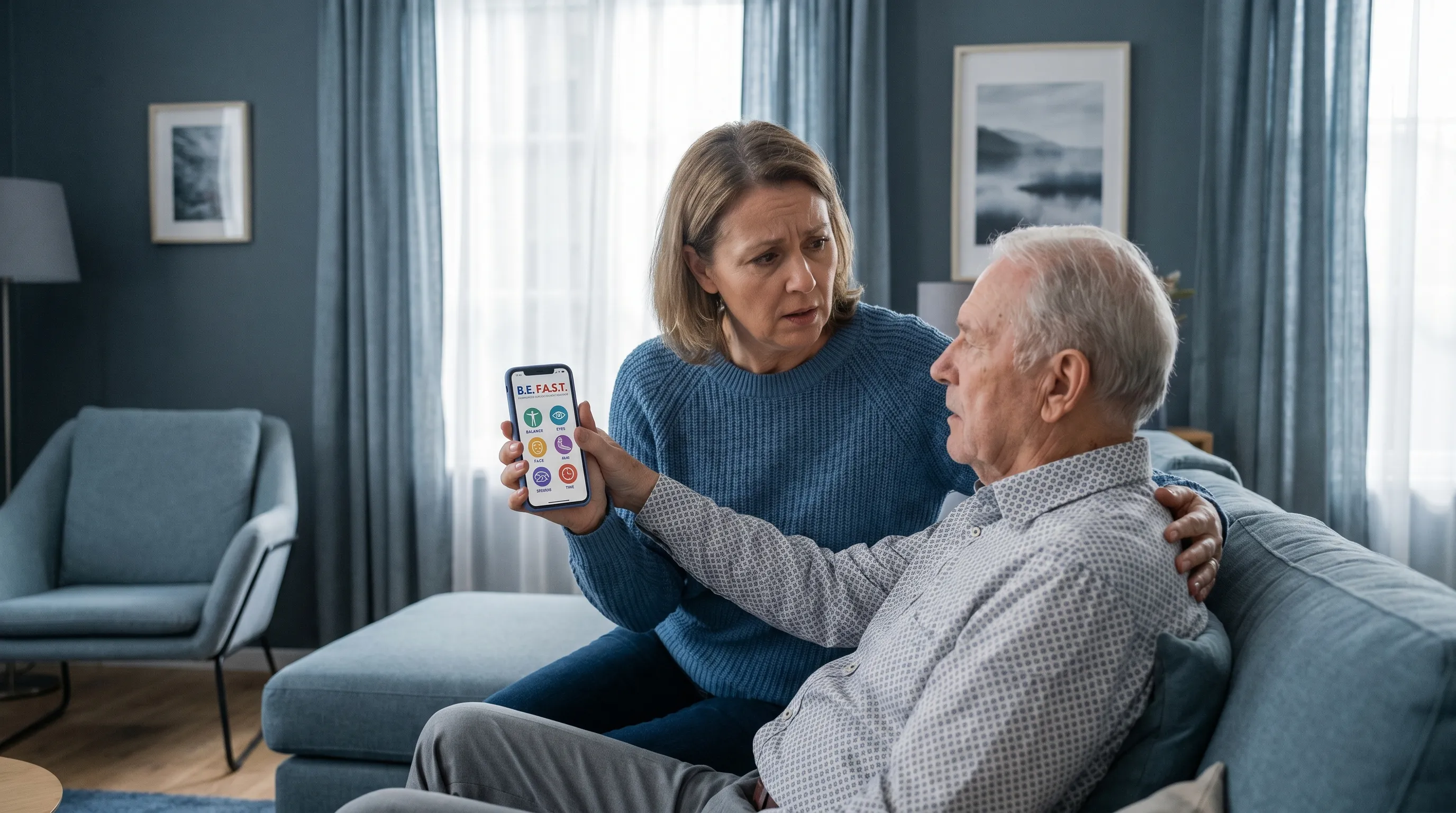
Deploy the B.E. F.A.S.T. Protocol Immediately. Check for Balance loss, Eye/vision changes, Face drooping, Arm weakness, Speech difficulty. If any are present, note the exact time symptoms began and Time to call emergency services (911/999) immediately.
Perform the Forehead Check (If Safe). While awaiting emergency responders, ask the person to raise both eyebrows. Inability to move the forehead on the drooping side strongly points toward a peripheral nerve issue like Bell's palsy. Preserved forehead movement with a drooping mouth strongly suggests stroke.
Document the Timeline. Emergency responders and neurologists rely heavily on the "last known well" time to determine thrombolytic eligibility. Be precise. When did the person last appear normal?
Protect the Eye if Bell's Palsy is Suspected. If emergency services have ruled out stroke and a physician diagnoses Bell's palsy, begin immediate eye care. Use preservative-free drops frequently, wear protective eyewear outdoors, and tape the eyelid shut during sleep. Avoid over-the-counter steroid eye drops unless prescribed.
Prioritize Rest & Stress Management. For Bell's palsy, supporting immune function through adequate sleep, hydration, and stress reduction can aid the natural inflammatory resolution process. Follow prescribed medication regimens exactly, tapering steroids only as directed.

Frequently Asked Questions
What are the main differences between Bell's palsy and stroke symptoms?
The primary differences lie in onset speed, forehead involvement, and associated neurological deficits. Bell's palsy develops gradually over days, completely paralyzes the affected side of the face (including the forehead and eye closure), and is often accompanied by ear pain, altered taste, or sound sensitivity. Stroke occurs suddenly, typically spares forehead movement, and frequently includes arm/leg weakness, severe headache, confusion, or speech impairment.
Can I treat Bell's palsy at home without seeing a doctor?
No. You should never self-diagnose facial paralysis. Because stroke can mimic Bell's palsy, immediate medical evaluation is essential to rule out life-threatening vascular events. Furthermore, Bell's palsy requires prescription corticosteroids within a 72-hour window for optimal outcomes. A physician must also assess for corneal exposure risk and rule out atypical causes like tumors or Lyme disease.
How long does it take to recover from Bell's palsy?
Most patients notice the first signs of improvement within three weeks of symptom onset. Significant recovery typically occurs between three and six months as the facial nerve regenerates. Complete recovery is seen in approximately 70 to 85 percent of cases. Recovery speed depends on the initial severity, age, and how quickly corticosteroid treatment is initiated.
Does Bell's palsy increase my risk of having a stroke in the future?
No current medical evidence suggests that Bell's palsy increases stroke risk. The two conditions have completely different pathophysiological origins. Bell's palsy involves localized peripheral nerve inflammation and viral reactivation, while stroke results from systemic vascular disease, atherosclerosis, hypertension, or embolic events. However, maintaining cardiovascular health is always recommended for overall longevity.
What should I do if my Bell's palsy isn't improving after three months?
If facial weakness persists beyond three months, or if symptoms worsen progressively, you must follow up with a neurologist or otolaryngologist. Persistent cases may require electromyography (EMG) to assess nerve viability, an MRI to rule out compressive lesions, or referral to a facial rehabilitation specialist. Surgical options like nerve grafting or muscle transfer are rarely considered until 6-12 months post-onset.
Why do doctors sometimes order blood tests for Bell's palsy?
While Bell's palsy is primarily diagnosed clinically, physicians may order targeted blood tests to identify underlying triggers in specific populations. These can include a Lyme disease titer in endemic regions, blood glucose levels (diabetes increases neuropathy risk), or inflammatory markers if sarcoidosis or an autoimmune condition is suspected. Routine blood work is not required for classic, unilateral presentations.
Key Takeaways
Distinguishing between bell's palsy vs stroke requires a systematic evaluation of onset timing, forehead mobility, and accompanying neurological signs. While both conditions can cause unilateral facial droop, stroke represents a central vascular emergency demanding immediate thrombolytic or surgical intervention within hours, whereas Bell's palsy is a peripheral inflammatory neuropathy managed with prompt corticosteroid therapy and supportive eye care within 72 hours. The forehead wrinkle test remains a highly reliable bedside differentiator due to bilateral cortical innervation of the upper facial muscles. Regardless of your suspicion, sudden facial paralysis warrants immediate medical evaluation to ensure accurate diagnosis and optimal outcomes. By understanding these critical differences and acting decisively, patients and caregivers can navigate neurological crises with confidence and clinical precision.
Disclaimer: This article is intended for educational purposes only and does not constitute medical advice. Always consult a qualified healthcare professional for diagnosis and treatment of any medical condition. If you suspect a stroke, call emergency services immediately. Sources: NIH National Institute of Neurological Disorders and Stroke (https://www.ninds.nih.gov/health-information/disorders/bells-palsy), American Stroke Association (https://www.stroke.org/en/about-stroke/stroke-symptoms), NHS UK (https://www.nhs.uk/conditions/bells-palsy/).
How we work
Researched and drafted with AI assistance, then reviewed by a human editor against the cited sources.
This article is general health information, not medical advice. Consult a qualified healthcare professional about your own situation.