Le cancer de stade 4 est-il terminal ? Pronostic et espoir

Points clés
- Incurable mais traitable : Cette expression décrit une maladie qui ne peut pas être complètement éradiquée, mais peut être prise en charge par un traitement continu. Les objectifs du traitement sont de contrôler la maladie, ralentir sa progression, réduire les tumeurs et prolonger la survie tout en maintenant une bonne qualité de vie. De nombreux cancers de stade 4 entrent désormais dans cette catégorie.
- Terminal : Une maladie est considérée comme terminale lorsqu'elle ne répond plus aux traitements visant à guérir ou à prolonger la vie. À ce stade, l'objectif des soins passe du contrôle du cancer à l'apport de confort, appelé soins palliatifs ou soins de fin de vie.
Un diagnostic de cancer de stade 4 est un événement qui bouleverse une vie, rempli d'incertitude et de peur. La première question qui vient souvent à l'esprit est lourde : « Est-ce terminal ? » Bien que le stade 4 représente la phase la plus avancée de la maladie, la réponse n'est plus un simple « oui ». Grâce à des avancées médicales remarquables, le paysage évolue d'un pronostic universellement terminal vers une situation où de nombreux cancers avancés peuvent être traités et pris en charge comme des maladies chroniques, prolongeant à la fois la durée et la qualité de vie.
Cet article propose un aperçu complet, étayé par des experts, de ce que signifie aujourd'hui un diagnostic de stade 4. Il va au-delà des statistiques pour explorer la réalité des traitements, l'importance de soins personnalisés et les raisons très réelles d'espérer.
Dans l'ère moderne de l'oncologie, le choc initial d'un diagnostic métastatique est fréquemment suivi d'une période de prise de décision complexe. Les patients et leurs familles doivent rapidement apprendre à naviguer dans un nouveau vocabulaire médical, comprendre des paradigmes de traitement en évolution et construire un réseau de soutien comprenant non seulement des oncologues, mais aussi des infirmiers spécialisés, des diététiciens, des professionnels de la santé mentale et des experts en soins palliatifs. Cette approche multidisciplinaire est devenue la norme dans les principaux centres de cancérologie, reconnaissant que survivre et bien vivre avec un cancer de stade 4 exige de traiter simultanément les dimensions biologiques, physiques, émotionnelles et logistiques de la maladie. À mesure que les protocoles de traitement se sophistiquent, le cadre de la prise de décision partagée se développe lui aussi, permettant aux patients de conserver autonomie et sens tout au long de leur parcours.
Comprendre la terminologie : cancer de stade 4 ou cancer terminal
Pour comprendre le pronostic, il est essentiel de clarifier d'abord les termes. Le langage employé par les professionnels de santé a un poids considérable, et la différence entre « stade 4 » et « terminal » est cruciale.
Calculateur gratuitTableau de Référence des Valeurs LaboTableau de référence complet pour les valeurs de laboratoire médicalesOuvrir le calculateurQue signifie un cancer de stade 4 ?
Un cancer de stade 4, aussi appelé cancer métastatique, signifie que le cancer s'est propagé (a métastasé) depuis son site d'origine vers des parties éloignées du corps. Des cellules cancéreuses peuvent se détacher de la tumeur primaire et voyager par la circulation sanguine ou le système lymphatique pour former de nouvelles tumeurs dans des organes tels que le foie, les poumons, les os ou le cerveau.
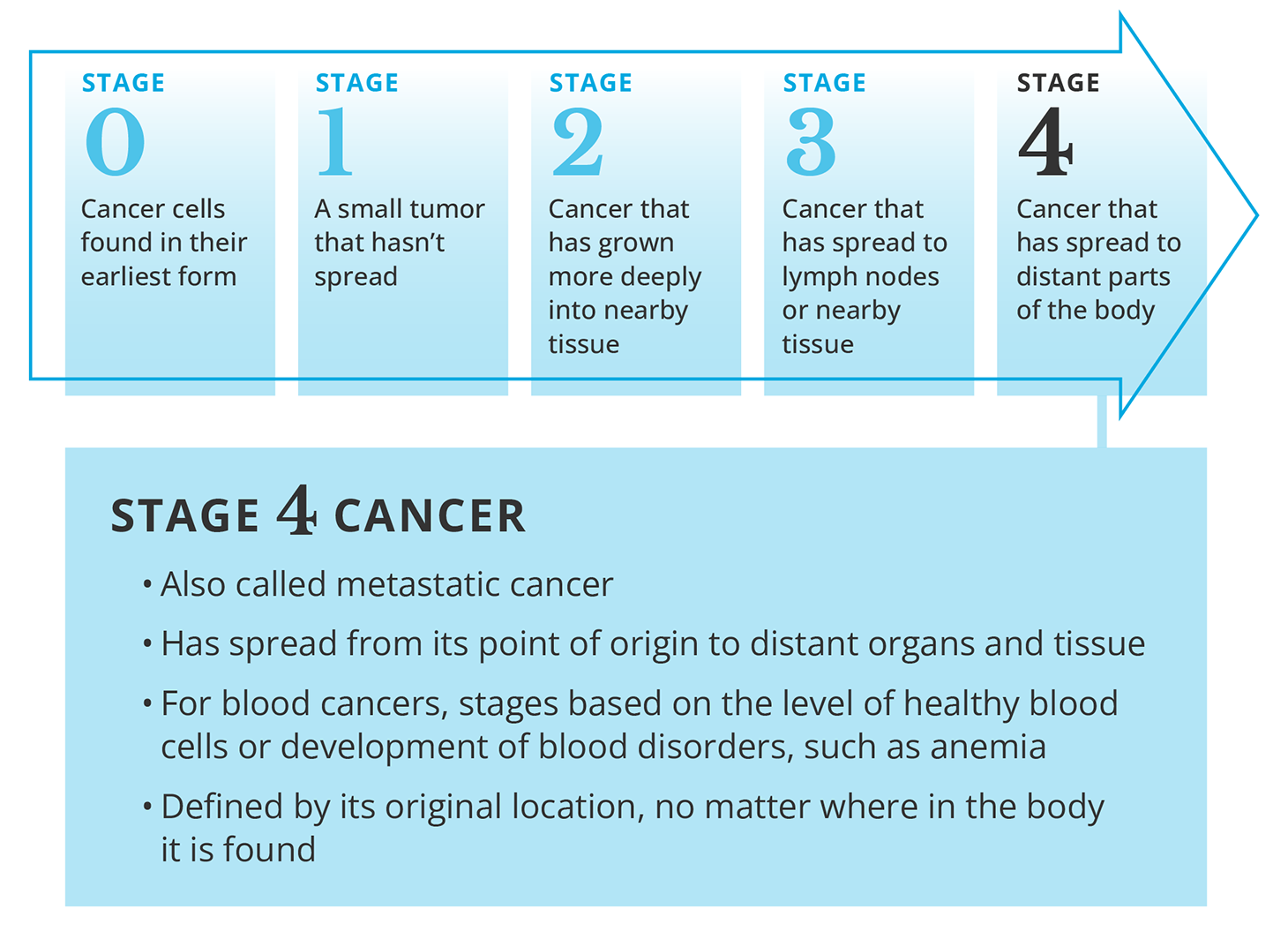 Source : Cancer Treatment Centers of America
Le stade d'un cancer aide les médecins à déterminer l'étendue de la maladie et à planifier le meilleur traitement. Il ne définit toutefois pas automatiquement l'issue.
Dans la pratique clinique, la stadification du cancer suit généralement le système TNM élaboré par l'American Joint Committee on Cancer (AJCC). Le « T » désigne la taille et l'étendue de la tumeur primaire, le « N » indique si des cellules cancéreuses se sont propagées aux ganglions lymphatiques voisins et le « M » signale la présence de métastases. Une désignation de stade 4 correspond à une classification « M1 », confirmant qu'une métastase à distance s'est produite, quelle que soit la taille de la tumeur primaire ou l'atteinte ganglionnaire. Comprendre cette progression biologique est essentiel, car elle explique pourquoi des traitements localisés tels que la chirurgie ou la radiothérapie locale seuls suffisent rarement. Des traitements systémiques, qui circulent dans l'ensemble de l'organisme, deviennent plutôt nécessaires pour atteindre les cellules cancéreuses microscopiques présentes dans le sang ou cachées dans des organes éloignés. Les recherches récentes sur la cascade métastatique ont montré que les cellules cancéreuses subissent une transition épithélio-mésenchymateuse (EMT) afin de se détacher du site primaire, de survivre à la surveillance immunitaire pendant leur déplacement et de coloniser de nouveaux tissus en s'adaptant à des microenvironnements complètement différents. L'analyse de ces mécanismes a directement mené au développement de traitements ciblant non seulement les cellules qui se divisent rapidement, mais aussi les voies spécifiques que le cancer utilise pour métastaser et échapper à la détection.
La distinction essentielle : « incurable mais traitable » ou « terminal »
Bien que les termes soient souvent utilisés de manière interchangeable dans la conversation, ils ont des significations médicales distinctes :
- Incurable mais traitable : Cette expression décrit une maladie qui ne peut pas être complètement éradiquée, mais peut être prise en charge par un traitement continu. Les objectifs du traitement sont de contrôler la maladie, ralentir sa progression, réduire les tumeurs et prolonger la survie tout en maintenant une bonne qualité de vie. De nombreux cancers de stade 4 entrent désormais dans cette catégorie.
- Terminal : Une maladie est considérée comme terminale lorsqu'elle ne répond plus aux traitements visant à guérir ou à prolonger la vie. À ce stade, l'objectif des soins passe du contrôle du cancer à l'apport de confort, appelé soins palliatifs ou soins de fin de vie.
L'impact psychologique de cette distinction est profond. Entendre « incurable mais traitable » peut insuffler un sentiment d'espoir et de capacité d'agir, donnant aux patients les moyens de participer activement à un plan de soins à long terme.
Les cliniciens déterminent si un cancer est passé de traitable à terminal à partir de marqueurs cliniques objectifs et d'échelles d'état fonctionnel. Lorsque plusieurs lignes de traitement systémique ne parviennent pas à arrêter la croissance tumorale, lorsque le cancer progresse rapidement malgré des interventions agressives et lorsque le déclin fonctionnel d'un patient rend tout traitement supplémentaire dangereux, le pronostic devient terminal. Cette transition n'est toutefois pas toujours brutale. De nombreux patients connaissent des périodes de maladie stable, appelées « plateaux de traitement », pendant lesquelles les examens d'imagerie ne montrent aucune nouvelle croissance durant de longues périodes. Pendant ces phases, les oncologues peuvent recommander un traitement d'entretien à doses plus faibles, voire des pauses thérapeutiques, afin de préserver la fonction immunitaire et de réduire la toxicité cumulative. Reconnaître la fluidité de l'évolution de la maladie permet aux patients et aux soignants d'ajuster leurs attentes de manière réaliste sans abandonner prématurément des options thérapeutiques qui pourraient encore offrir un bénéfice significatif.
Pourquoi un diagnostic de stade 4 n'est pas uniforme : les facteurs qui déterminent votre pronostic
Aucun cas de cancer n'est identique à un autre. Un diagnostic de stade 4 n'est pas une sentence uniforme ; les perspectives sont très individuelles et dépendent de plusieurs facteurs clés.
Le type de cancer compte le plus
Le facteur le plus important pour déterminer le pronostic est le type de cancer. Les taux de survie des cancers de stade 4 varient considérablement selon le type de cancer.
Selon le programme Surveillance, Epidemiology, and End Results (SEER) du National Cancer Institute, les taux de survie relative à 5 ans des cancers à un stade distant mettent cette variation en évidence :
| Type de cancer | Taux de survie relative à 5 ans |
|---|---|
| Prostate | 34,1 % |
| Sein | 31 % |
| Colorectal | 15,6 % |
| Poumon | 8,2 % |
| Estomac | 6,6 % |
Source : Medical News Today, citant des données SEER
Il est essentiel de se rappeler : il s'agit de statistiques fondées sur de grands groupes de personnes diagnostiquées dans le passé. Elles ne prédisent pas l'issue pour une personne donnée et peuvent ne pas refléter l'impact des tout derniers traitements.
En outre, ces taux de survie agrégés accusent un décalage temporel important. SEER et les autres registres fondés sur la population publient généralement des données qui ont plusieurs années de retard sur la réalité clinique actuelle. Un patient à qui l'on diagnostique un adénocarcinome pulmonaire de stade 4 en 2024 ne fait pas face à la même réalité statistique qu'un patient diagnostiqué en 2015, en raison de l'approbation rapide par la FDA de nouveaux inhibiteurs de points de contrôle, de conjugués anticorps-médicament et de thérapies ciblées au cours de la dernière décennie. La différenciation des sous-types joue également un rôle considérable. Par exemple, le « cancer du poumon » englobe le cancer du poumon non à petites cellules (CPNPC) et le cancer du poumon à petites cellules (CPPC), qui présentent chacun des comportements biologiques, algorithmes de traitement et pronostics très différents. Rien que dans le cancer du sein, les résultats au stade 4 varient fortement selon le statut des récepteurs hormonaux (ER/PR) et l'amplification de HER2. Comprendre ces sous-catégories moléculaires est la première étape pour obtenir un pronostic précis et personnalisé.
Autres facteurs clés influençant les perspectives
Outre le type de cancer, votre équipe médicale prendra en considération :
- L'âge et l'état de santé général du patient : Les patients plus jeunes et ceux qui présentent moins d'autres problèmes de santé ont généralement de meilleurs résultats.
- Localisation des métastases : Le lieu où le cancer s'est propagé peut influencer les options de traitement et le pronostic.
- Profil génétique du cancer : Des mutations génétiques spécifiques dans une tumeur peuvent la rendre vulnérable à de nouveaux traitements ciblés très efficaces.
- Réponse au traitement : La façon dont un cancer répond au traitement initial est un indicateur important du pronostic à long terme.
En plus de ces éléments fondamentaux, les oncologues s'appuient fortement sur des outils d'évaluation standardisés pour évaluer la tolérance au traitement et l'espérance de vie. L'échelle d'état fonctionnel de l'Eastern Cooperative Oncology Group (ECOG), par exemple, classe un patient de 0 (entièrement actif) à 5 (décédé), ce qui est directement corrélé aux résultats de survie et à l'éligibilité aux traitements. Les patients ayant un score de 0-2 tolèrent habituellement bien les schémas systémiques agressifs, tandis que ceux ayant un score de 3-4 peuvent nécessiter une dose modifiée ou une orientation vers la prise en charge des symptômes. Des affections associées telles qu'un diabète non contrôlé, une maladie cardiovasculaire ou une maladie rénale chronique peuvent aussi compliquer le traitement en limitant l'utilisation de certaines chimiothérapies ou thérapies ciblées nécessitant une élimination hépatique ou rénale. De plus, l'accès à des centres de soins spécialisés, l'admissibilité aux essais cliniques et la capacité à suivre des programmes médicamenteux complexes influencent significativement les résultats en conditions réelles. Les facteurs socioéconomiques, la littératie en santé, la couverture d'assurance et la proximité géographique de réseaux complets de cancérologie peuvent créer des inégalités dans la fourniture des soins, ce qui rend essentiel pour les patients de se défendre eux-mêmes ou de solliciter l'aide de navigateurs de patients et de travailleurs sociaux en oncologie.
Une nouvelle ère d'espoir : comment les traitements modernes transforment les perspectives
Le récit autour du cancer de stade 4 est réécrit par des avancées révolutionnaires dans des traitements plus précis et personnalisés que jamais.
L'objectif du traitement : passer de la guérison au contrôle
Pour la plupart des cancers de stade 4, l'objectif principal passe d'une guérison complète à un contrôle à long terme. Le traitement vise à :
- Ralentir ou arrêter la croissance des cellules cancéreuses.
- Réduire les tumeurs existantes.
- Prendre en charge des symptômes comme la douleur ou l'essoufflement.
- Prolonger la vie et améliorer sa qualité.
Ce paradigme de prise en charge des maladies chroniques reflète les approches utilisées avec succès en cardiologie, en endocrinologie et en rhumatologie. Tout comme les personnes atteintes de diabète de type 1 ou du VIH gèrent quotidiennement leur maladie par des médicaments, une surveillance et des ajustements de leur mode de vie, de nombreux patients atteints de cancer de stade 4 prennent désormais des thérapies ciblées par voie orale ou reçoivent des immunothérapies programmées afin de maîtriser la maladie. Le séquençage des traitements est devenu très stratégique. Les oncologues commencent souvent par des schémas de première intention équilibrant efficacité et tolérance, et réservent des traitements plus agressifs ou novateurs aux lignes suivantes à mesure que la résistance apparaît. Cette approche par « ligne de traitement » optimise les résultats à long terme en réduisant la fatigue, la neuropathie ou les atteintes d'organes liées aux traitements. En outre, la biopsie liquide révolutionne la surveillance. En analysant l'ADN tumoral circulant (ctDNA) à partir de simples prises de sang, les cliniciens peuvent détecter une rechute moléculaire plusieurs mois avant qu'elle ne soit visible sur les scanners ou TEP traditionnels. Ce système d'alerte précoce permet des ajustements préventifs du traitement, susceptibles d'éviter une progression symptomatique et de prolonger les intervalles de survie sans progression.
Des traitements révolutionnaires qui changent les règles
La chimiothérapie conventionnelle n'est plus la seule option. L'arrivée de nouveaux traitements entraîne des réponses durables à long terme chez des patients qui disposaient auparavant de peu d'options.
- Immunothérapie : Ces médicaments mobilisent le système immunitaire de l'organisme pour repérer et détruire les cellules cancéreuses. Ils ont montré un succès remarquable dans le traitement de cancers avancés tels que le mélanome et le cancer du poumon non à petites cellules.
- Thérapie ciblée : Ces traitements attaquent les cellules cancéreuses présentant des mutations génétiques spécifiques, souvent avec moins d'effets indésirables que la chimiothérapie traditionnelle.
- Techniques chirurgicales et interventionnelles avancées : Chez certains patients, par exemple ceux dont le cancer colorectal ne s'est propagé qu'au foie, des traitements agressifs comme les pompes d'administration intra-artérielle hépatique (HAI), voire les greffes de foie, peuvent conduire à une survie à long terme et, dans certains cas sélectionnés, à une guérison.
« Il n'y a pas si longtemps, le cancer colorectal de stade 4 était considéré comme une maladie terminale. Mais de nouvelles découvertes thérapeutiques continuent d'améliorer les résultats et les taux de survie des patients. Il y a de nombreuses raisons d'espérer. » - Dr Lauren Dias, Mass General Cancer Center. Source
L'immunothérapie a fondamentalement fait évoluer l'oncologie, passant de la destruction cytotoxique des cellules à la modulation immunitaire. Les inhibiteurs de points de contrôle (tels que les inhibiteurs de PD-1, PD-L1 et CTLA-4) agissent en levant les « freins » moléculaires que les cellules cancéreuses imposent aux lymphocytes T, ce qui permet au système immunitaire de reconnaître et d'éliminer les tissus malins. Toutefois, les taux de réponse varient, ce qui suscite une recherche intensive sur des biomarqueurs tels que la charge mutationnelle tumorale (TMB) et l'instabilité microsatellitaire élevée (MSI-H) afin de prédire les patients qui en bénéficieront. Lorsque l'immunothérapie ne déclenche pas de réponse, des stratégies combinées émergent, associant des inhibiteurs de points de contrôle à la radiothérapie, à la chimiothérapie ou à des vaccins anticancéreux pour créer un effet synergique. Les thérapies ciblées se sont développées de façon exponentielle avec l'avènement du séquençage de nouvelle génération (NGS). Les panels peuvent désormais rechercher simultanément des dizaines de mutations actionnables, notamment EGFR, ALK, ROS1, BRAF, KRAS G12C et les fusions NTRK. Le développement des conjugués anticorps-médicament (ADC) constitue une autre avancée majeure : ils fonctionnent comme des « missiles guidés » qui fixent des charges très toxiques directement aux récepteurs de surface spécifiques du cancer, épargnant les cellules saines et réduisant les effets indésirables systémiques. Parallèlement, la radio-oncologie a adopté la radiothérapie stéréotaxique corporelle (SBRT) et la protonthérapie, permettant une délivrance très précise de fortes doses sur des lésions oligométastatiques (habituellement 1-5 métastases). Cette approche, parfois appelée « thérapie dirigée contre les oligométastases », a montré que l'éradication de dépôts métastatiques limités peut retarder la progression systémique et, dans certains cas sélectionnés, induire une rémission à long terme.
Récits de résilience : vivre avec un cancer de stade 4
Au-delà des données, il existe des récits puissants de personnes qui ont déjoué leur pronostic initial. Le vétéran de l'US Navy Matthew Roach, après avoir reçu un diagnostic de cancer de la prostate métastatique terminal de stade 4, a suivi un traitement agressif à la clinique VA de Lubbock. Un an plus tard, son taux de PSA était indétectable et il a sonné une « cloche de célébration » qu'il avait offerte pour inspirer les autres. Son histoire est un symbole puissant de survie et de l'impact de soins dévoués.
!Doctor and patient discussing scan results on a tablet in a modern clinic.:max_bytes(150000):strip_icc()/stage-4-cancer-5092070_color-b41add690efd427294f126c16723372c.jpg) Source : MedlinePlus - Advanced Cancer
Les récits des patients mettent aussi en lumière l'importance cruciale de la résilience psychosociale, du soutien communautaire et de l'accompagnement financier. De nombreux survivants de stade 4 attribuent aux groupes de soutien par les pairs, aux communautés de cancer en ligne et aux thérapies intégratives comme la réduction du stress basée sur la pleine conscience (MBSR), l'acupuncture et les programmes d'exercice supervisés une aide précieuse pour faire face au poids émotionnel d'un diagnostic chronique. Des organisations telles que l'American Cancer Society, CancerCare et la Leukemia & Lymphoma Society proposent gratuitement du conseil, une aide au transport, une prise en charge des quotes-parts et des ateliers éducatifs qui permettent aux patients de rester acteurs de leurs soins. Les survivants soulignent fréquemment l'intérêt de préserver des routines, de se fixer des objectifs réalisables et de trouver un sens au-delà du diagnostic, que ce soit par le plaidoyer, l'expression créative, le bénévolat ou le mentorat de patients nouvellement diagnostiqués. Ces piliers non cliniques de la survie ne remplacent pas le traitement médical, mais ils influencent profondément la capacité d'un patient à tolérer le traitement, à respecter ses rendez-vous et à préserver son bien-être mental tout au long d'un parcours long et imprévisible.
Parcourir ce chemin : qualité de vie ou quantité de vie
L'accent mis sur la prise en charge à long terme fait émerger une conversation cruciale : il faut mettre en balance la recherche d'une vie plus longue et la qualité de cette vie. C'est une négociation profondément personnelle.
Le choix personnel au cœur du traitement
Les traitements agressifs visant à prolonger la vie peuvent entraîner des effets indésirables importants, tels que nausées, fatigue et douleur. La décision de suivre un traitement particulier implique un dialogue continu entre vous, votre famille et votre équipe soignante. Il est essentiel de communiquer vos valeurs, vos objectifs et vos craintes afin que votre plan de traitement corresponde à ce qui compte le plus pour vous.
Les cadres de prise de décision partagée sont désormais la norme en oncologie et utilisent des outils tels que les aides à la décision, les exercices de clarification des valeurs et les consultations structurées de définition des objectifs. Les patients sont encouragés à exprimer ce qu'ils souhaitent privilégier : assister à la remise des diplômes d'un petit-enfant ? Préserver une clarté cognitive pour continuer à travailler ? Voyager ? Ou simplement réduire les visites à l'hôpital ? Les oncologues peuvent alors adapter les schémas de traitement en conséquence. Par exemple, un patient qui privilégie la fonction cognitive peut éviter les chimiothérapies qui pénètrent dans le cerveau et provoquent un « brouillard de chimio », préférant des agents ciblés au profil neurologique plus net. La fatigue, l'un des effets indésirables les plus répandus, peut être prise en charge par des programmes d'exercice progressif, l'optimisation de l'hygiène du sommeil, la correction de l'anémie et parfois des stimulants pharmacologiques. Les nausées et vomissements sont désormais très contrôlables grâce à des antiémétiques modernes, tels que les antagonistes des récepteurs NK-1 et les inhibiteurs 5-HT3, permettant aux patients de manger normalement et de conserver leur état nutritionnel. La prise en charge de la douleur suit l'échelle analgésique de l'Organisation mondiale de la Santé, allant des AINS aux opioïdes, aux modulateurs de la douleur neuropathique (gabapentine, duloxétine) et aux procédures interventionnelles comme les blocs nerveux ou les cathéters périduraux lorsque nécessaire. En gérant les symptômes de manière proactive plutôt qu'en y réagissant, les équipes de traitement peuvent préserver l'autonomie fonctionnelle et garantir que les prolongations de vie restent porteuses de sens.
Le rôle essentiel des soins palliatifs et des soins de fin de vie
Il est courant de croire à tort que les soins palliatifs ne concernent que la fin de vie.
- Soins palliatifs (soins de soutien) : Leur objectif principal est d'améliorer votre qualité de vie en prenant en charge les symptômes du cancer et les effets indésirables du traitement. Ils peuvent et doivent être intégrés dès le moment du diagnostic et dispensés parallèlement aux traitements destinés à contrôler le cancer.
- Soins de fin de vie : Il s'agit d'un type particulier de soins palliatifs pour les patients dans leurs derniers mois. L'objectif passe entièrement au confort lorsque les traitements visant à guérir ou à prolonger la vie ne sont plus possibles ou ne sont plus souhaités.
L'intégration précoce de soins palliatifs a été montrée à maintes reprises, dans des essais cliniques randomisés, comme améliorant la survie, réduisant les visites aux urgences, diminuant les scores de dépression et d'anxiété et augmentant la satisfaction globale à l'égard des soins. Les spécialistes des soins palliatifs travaillent parallèlement aux oncologues médicaux : ils prennent en charge des symptômes complexes, facilitent les réunions de famille, abordent la détresse spirituelle et aident les patients à établir des directives anticipées. Ils savent aussi mener les conversations difficiles sur le pronostic, aider les patients à distinguer l'espoir réaliste du faux espoir et veiller à ce que les soins restent alignés sur l'évolution des valeurs du patient à mesure que la trajectoire de la maladie change. Lorsque les soins de fin de vie deviennent appropriés, ils apportent un soutien complet dans le lieu de préférence du patient, comprenant les médicaments, le matériel médical, les visites infirmières, le soutien au deuil pour les familles et le répit pour les aidants épuisés. La transition vers les soins de fin de vie n'est pas un échec du traitement ; c'est une réorientation médicalement et éthiquement justifiée qui donne la priorité à la dignité, au confort et à la sérénité pendant le dernier chapitre de la vie.
Questions fréquentes sur le cancer de stade 4
Combien de temps peut-on vivre avec un cancer de stade 4 ? Il n'existe pas de réponse unique, car l'espérance de vie avec un cancer de stade 4 varie considérablement selon le type de cancer, son profil génétique, la réponse au traitement et l'état de santé général du patient. Si certains cancers agressifs ont un pronostic de quelques mois, les progrès thérapeutiques permettent aujourd'hui à de nombreux patients de vivre pendant des années en gérant la maladie comme une affection chronique. Les statistiques de survie médiane continuent de s'améliorer d'année en année à mesure que de nouveaux agents entrent dans la pratique clinique. Certains patients obtiennent des rémissions durables à long terme pendant des décennies, en particulier pour les cancers offrant de fortes possibilités de thérapie ciblée ou une immunogénicité élevée.
Un cancer de stade 4 peut-il être guéri ou entrer en rémission ? Une guérison complète d'un cancer de stade 4 est rare, car le cancer s'est propagé dans tout l'organisme. Toutefois, le traitement peut conduire à une rémission à long terme, lorsque les symptômes disparaissent et que le cancer devient indétectable aux examens. Dans ces cas, le cancer est pris en charge et contrôlé, mais n'est pas considéré comme définitivement guéri. La notion d'« absence de signe de maladie » (NED) ou de « réponse métabolique complète » aux examens TEP est très encourageante et permet souvent aux patients de reprendre des activités normales, bien qu'une surveillance continue reste nécessaire pour détecter une récidive moléculaire.
Existe-t-il un cancer de stade 5 ? En général, non. Le système standard de stadification du cancer pour la plupart des cancers de l'adulte va du stade 0 au stade 4. Le stade 4 est le stade le plus avancé et indique la présence de métastases. Le terme « stade 5 » est une idée fausse, bien qu'il soit utilisé pour un cancer rénal pédiatrique spécifique (tumeur de Wilms) afin de décrire les cas touchant les deux reins. L'oncologie pédiatrique utilise parfois des systèmes de stadification modifiés, mais pour les carcinomes et sarcomes de l'adulte, le stade 4 reste la désignation définitive d'une propagation systémique.
Quels sont les symptômes d'un cancer de stade 4 ? Les symptômes dépendent de l'endroit où le cancer s'est propagé. Par exemple :
- Os : Douleur osseuse, fractures.
- Cerveau : Maux de tête, convulsions, étourdissements.
- Poumons : Essoufflement, toux persistante.
- Foie : Jaunisse (jaunissement de la peau et des yeux), gonflement abdominal.
Des symptômes systémiques supplémentaires peuvent comprendre une perte de poids inexpliquée, une fatigue persistante, des sueurs nocturnes, une perte d'appétit et une faiblesse généralisée. Les métastases osseuses nécessitent fréquemment des bisphosphonates ou des inhibiteurs du ligand RANK (comme le dénosumab) afin de prévenir les événements osseux. Les métastases cérébrales sont souvent traitées par des corticoïdes pour réduire l'œdème cérébral, en plus d'une radiothérapie ciblée ou d'une intervention neurochirurgicale lorsque possible. L'atteinte hépatique peut altérer le métabolisme des médicaments et nécessite des ajustements de dose attentifs ainsi qu'un conseil nutritionnel pour prendre en charge la dénutrition protéino-calorique. Il est crucial de signaler rapidement tout symptôme nouveau ou qui s'aggrave à votre équipe soignante, car une intervention précoce peut prévenir les complications, les hospitalisations et les atteintes irréversibles aux organes.
Conclusion : redéfinir la vie au-delà d'un diagnostic de stade 4
Alors, un cancer de stade 4 est-il terminal ? Bien qu'il s'agisse du stade le plus grave et le plus avancé de la maladie, ce n'est pas toujours un diagnostic terminal. Les perspectives sont plus porteuses d'espoir et plus nuancées que jamais. Il s'agit d'une affection grave, souvent incurable, mais aussi de plus en plus traitable.
Le parcours est très individuel, défini par votre cancer spécifique, votre santé et vos objectifs personnels. Une communication ouverte et honnête avec votre équipe médicale est l'outil le plus puissant dont vous disposez. En comprenant vos options et en définissant vos priorités, vous pouvez avancer avec clarté, capacité d'agir et espoir.
Pour avancer concrètement, commencez par demander un profil moléculaire complet de votre tumeur afin d'identifier toutes les options possibles de thérapie ciblée. Demandez un second avis auprès d'un centre de cancérologie désigné par le National Cancer Institute (NCI), où des réunions de concertation pluridisciplinaires examinent les cas complexes et où des spécialistes de l'appariement aux essais cliniques peuvent identifier des protocoles de pointe indisponibles localement. Préparez les rendez-vous d'oncologie avec une liste écrite de questions centrées sur les objectifs du traitement, les effets indésirables attendus, les calendriers de surveillance et les plans de secours en cas de progression de la maladie. Construisez votre écosystème de soutien en vous mettant en relation avec des travailleurs sociaux diplômés spécialisés en oncologie, des nutritionnistes certifiés, des professionnels de la santé mentale et des mentors pairs. N'oubliez pas que la prise en charge d'un cancer de stade 4 est un marathon, pas un sprint, et exige résilience, adaptabilité et défense inébranlable de vos intérêts. Avec l'expansion continue des arsenaux thérapeutiques, l'amélioration des soins de soutien et une communauté grandissante de survivants à long terme, vivre pleinement avec un cancer avancé devient de plus en plus une réalité. Votre diagnostic est un chapitre de votre vie, mais avec la médecine moderne et des soins intentionnels, il ne doit pas nécessairement être la fin de votre histoire.
Références
- American Cancer Society
- Cancer Treatment Centers of America. (2024). What Is Stage 4 Cancer and How Is Stage Four Treated?
- Kandola, A. (2020). Is stage 4 cancer curable? Survival rates and outlook. Medical News Today.
- Mass General Brigham. (2025). Stage 4 Colorectal Cancer Treatments Offer Hope.
- National Cancer Institute (NCI)
- VA Amarillo Health Care. (2025). Symbol of Survival: Navy Veteran defies stage 4 cancer diagnosis.
Comment nous travaillons
Recherché et rédigé avec l'aide de l'IA, puis relu par un éditeur humain au regard des sources citées.
Cet article fournit des informations générales de santé, non un avis médical. Consultez un professionnel de santé qualifié pour votre situation.